Once upon a time there was a preschool in the bowels of the club. I know. I lived it. A little history. The post WW2 period brought much development and young families to Seattle’s north end. Actually, it wasn’t a city yet. In the late 1940s and early 1950s, the Seattle School District and later the community college system saw a need to develop “playgroups” which would offer parents and there preschoolers time to socialize, learn and bond in a classroom setting. The catch was each parent would assist the teacher one day per week for the half-day program. It included a parent education component as well. Back to Haller Lake. The parent cooperative model thrived in the basement of the Club between 1946 and 1973 and was instrumental in raising Club membership. Thinking back, Club members were younger and had young children. There was a true symbiotic relationship between the two. In 1973 the Club decided not to...
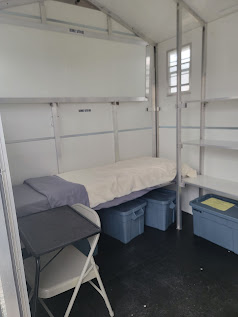
I was able to tour the Catholic Community Services Homeless Shelter, Junction Point, last week. This shelter is located at 1132 N 128th St. near Stone Way and 128th St. There shelter is a series of small, individual building for the residents that look something like "tiny homes". I met up with Sharonda Duncan, Division Director within CSS Homeless Services. She manages 4 of CCS's shelters around Seattle. This shelter became active last June. It has capacity for 49 individuals, men or women who are 50 years old or older. The shelter is currently at full capacity. The shelter does utilize volunteers from the community. They can use help with their plants/gardening and putting together hygiene packs and move out packs for the residents. If you are interested, you can visit the shelter and ring the door bell. This is a shelter that moved from the old Junction Point location along Elliot Avenue. The Elliot avenue shelte...
Last Thursday night, Noah Fay came to speak to the HLCC community regarding the Downtown Emergency Service Center (DESC) shelters in our neighborhood. Noah is the DESC housing director having worked there for 18 years. DESC has been around since the 1970s and has primarily been known for offering congregate shelters for the Seattle single adult homeless population. A congragate shelter is one in which residents share a sleeping space either on floor mats or in bunks. But, in general, the residents are in close proximity to each other. With the COVID pandemic, the close proximity presented a challenge for social distancing. As a result, DESC was able to secure the use of a hotel in Renton to house the residents. The residents got a their own spaces which afforded greater privacy and autonomy than the congregate shelters. Noah explained how the move to to hotel made significant differences in the stability and wellbeing for many residents that had...
Fall-toush Salad by Smitten Kitchen Submitted by Patricia Stordeur Here is a great fall salad. I love to use it as a side for big holiday meals. These proportions serve 2, so double or triple the ingredients for a larger crowd. Leftovers are also wonderful. Ingredients for the salad: 3 tablespoons olive oil, possibly plus another spoonful 1 1/4 pound delicata squash (one medium) 1/2 pound brussels sprouts Salt and freshly ground black pepper or Aleppo pepper flakes to taste 1 large pita bread Kosher salt 2 scallions, thinly sliced About 1 tablespoon mint leaves, finely chopped About 1 tablespoon flat-leaf parsley or cilantro leaves, finely chopped Additional ground sumac or paprika, to finish Ingredients for the dressing: 2 teaspoons ground sumac or paprika (but sumac is so much better in this salad!) 2 teaspoons warm water 1 to 2 tablespoons lemon juice 1 small garlic clove, minced 1 teaspoon white wine vinegar 4 tablespoons olive oil S...



Comments
Post a Comment