Once upon a time there was a preschool in the bowels of the club. I know. I lived it. A little history. The post WW2 period brought much development and young families to Seattle’s north end. Actually, it wasn’t a city yet. In the late 1940s and early 1950s, the Seattle School District and later the community college system saw a need to develop “playgroups” which would offer parents and there preschoolers time to socialize, learn and bond in a classroom setting. The catch was each parent would assist the teacher one day per week for the half-day program. It included a parent education component as well. Back to Haller Lake. The parent cooperative model thrived in the basement of the Club between 1946 and 1973 and was instrumental in raising Club membership. Thinking back, Club members were younger and had young children. There was a true symbiotic relationship between the two. In 1973 the Club decided not to...
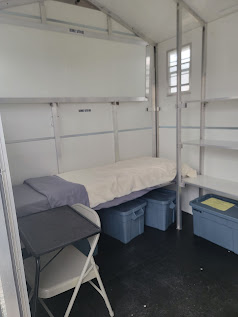
I was able to tour the Catholic Community Services Homeless Shelter, Junction Point, last week. This shelter is located at 1132 N 128th St. near Stone Way and 128th St. There shelter is a series of small, individual building for the residents that look something like "tiny homes". I met up with Sharonda Duncan, Division Director within CSS Homeless Services. She manages 4 of CCS's shelters around Seattle. This shelter became active last June. It has capacity for 49 individuals, men or women who are 50 years old or older. The shelter is currently at full capacity. The shelter does utilize volunteers from the community. They can use help with their plants/gardening and putting together hygiene packs and move out packs for the residents. If you are interested, you can visit the shelter and ring the door bell. This is a shelter that moved from the old Junction Point location along Elliot Avenue. The Elliot avenue shelte...
This one is a stinker…literally. It’s everything you wanted to know about dumps and dumping around Haller Lake past and present. In the old days ,say, prior to the 1930’s, people would use fire pits, burn barrels or burial pits to dispose of waste. No rules applied. It was also common to dump trash in any vacant lot. The North End Herald reported in 1927 that Haller Lake, under King County jurisdiction (before Seattle annexation), would acquire a drive in dump on both sides of 125th just east of North Trunk Highway (Aurora today). The article says “A man will be in charge and supervise disposal.” Twenty years later, 1947, a group of Haller Lake residents meet with King County commissioners complaining of the dump eyesore, smoke and stench. One comment from a Lake neighbor, “We’re ashamed about it, we have to tell our friends come out Aurora Ave. and turn right at the dump.” Although the commissioners said they’d in...
This is a recruiting post. There are about 750,000 people living in Seattle, and perhaps another 50,000 visitors at any given time. There are about 8,000 emergency responders: police, fire fighters, ambulance drivers, and similar. In an earthquake, a large fire, a major power failure, civil disturbance, or other disaster, the emergency responders will be overwhelmed. We might survive the earthquake only to die in the aftermath. Recognizing this problem, a group of volunteers have formed the Seattle Emergency Hubs (See Emergency Preparedness, Disaster Awareness | Seattle Emergency Hubs ). We have created list of about 127 hubs of which 65 are active and 62 are not yet active. The Haller Lake Emergency Hub (HLEH) is considered active, since it has a hub captain (me) and an active grant application. The Haller Lake P-Patch Emergency Hub (HLPEH), by way of contrast, is not yet active, because it does not have a hub captain nor anyt...


Comments
Post a Comment